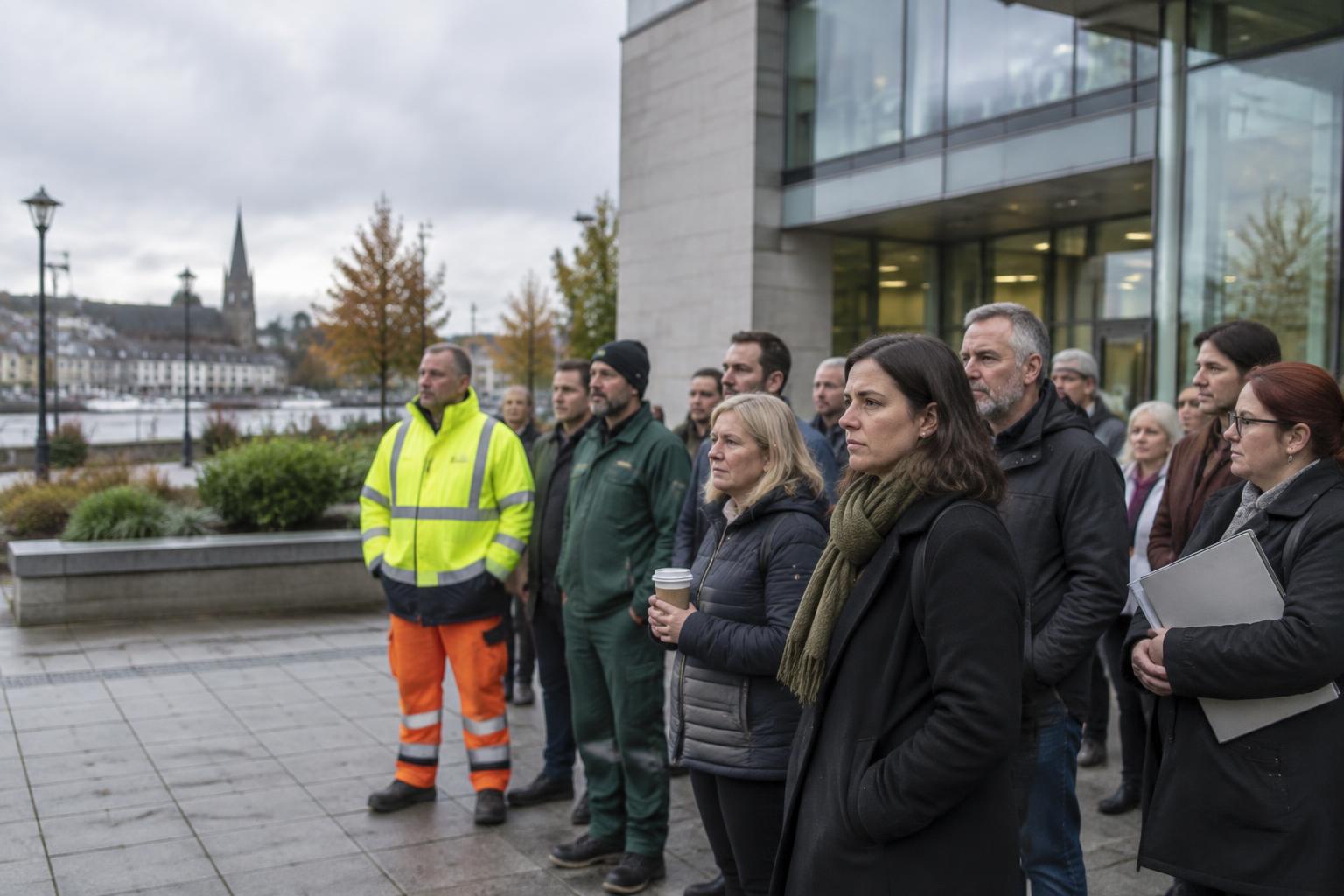
More than 100,000 public sector workers began a work-to-rule this week, and a national one-day strike is confirmed for 14 October — placing Ireland's 31 local authorities at the centre of a twelve-day countdown.
Where Things Stand
More than 100,000 public sector workers began industrial action this week in the form of a work-to-rule, and a national one-day strike is now confirmed for Wednesday 14 October 2026. The action is being coordinated by the Public Services Committee of the Irish Congress of Trade Unions, with 19 affiliated unions moving in a staged escalation that began on 30 September and is scheduled to intensify with the full strike in twelve days' time — and potentially a second strike on 21 October if the dispute remains unresolved.
The cause is straightforward: the previous public sector pay deal expired at the end of June 2026. It had provided for general pay increases of 9.25% for public sector workers, along with a 1% local bargaining fund. Formal talks on a successor agreement have yet to begin. Unions say the Government has refused to address cost-of-living pressures at the outset of any negotiating process. The Government says it is willing to engage but without preconditions. As of Thursday 1 October 2026, union leaders wrote to Minister for Public Expenditure Jack Chambers stating there is currently no basis for them to enter pay negotiations. The two sides have not sat down together.
What This Means for Local Authorities Specifically
For Ireland's 31 city and county councils, the 14 October strike is not an abstract national story — it is an operational crisis with a specific twelve-day countdown attached to it. Fórsa, the largest union representing local authority workers, served notice of industrial action on local authority employers on 18 September 2026. Its Local Government and Local Services division represents 12,000 members employed in city and county councils and regional assemblies nationwide. Its Municipal Division represents a further 1,500 members working in Dublin City Council specifically. Both divisions commenced work-to-rule action on Wednesday 30 September, withdrawing cooperation with new work practices, working groups, national committees and AI initiatives.
SIPTU's local authority members received notice of industrial action commencing from 30 September, with SIPTU Divisional Organiser Brendan O'Brien confirming in a direct message to members that the dispute would escalate to two 24-hour stoppages — one on 14 October and a second on 21 October — if the work-to-rule failed to produce movement from the Government. SIPTU represents significant numbers of operative and frontline local authority staff across refuse collection, roads maintenance, parks and public realm services — the visible, public-facing work that residents notice most directly when it stops.
The practical implication across every county council and city council in the State is that from Wednesday 30 September, local authority services have been operating under a work-to-rule that restricts what staff will do beyond contracted hours and terms. By 14 October, if the dispute has not been resolved, those services will stop entirely for a day — and potentially for two days if the 21 October date also proceeds.
The Pay Dispute in Detail
The unions' position rests on a specific claim: that public sector workers have experienced a real-terms pay cut of at least 5% since 2020, when the cost of living is factored in. That 5% figure reflects the period of elevated inflation that ran from 2022 through 2024 and which eroded the purchasing power of pay increases negotiated before the inflation surge arrived. The previous pay deal — Building Momentum, extended through several phases — was designed for a lower-inflation environment and did not contain provisions that automatically adjusted pay to track actual price increases. Unions say the successor deal must address that shortfall as a starting point. The Government says pay increases must be agreed through a structured negotiating process rather than pre-committed to before talks begin.
Fórsa general secretary Kevin Callinan — who also chairs the ICTU Public Services Committee — has framed the dispute in terms of process as much as quantum. "The last public service pay agreement expired at the end of June. Attempts to engage on a successor agreement came to nothing because of the Government's steadfast refusal to address cost-of-living pressures at the outset," he said on 30 September. "The Minister for Public Expenditure has variously described union ballots as 'unnecessary' and any industrial action as 'unfair', but it is the Minister's own refusal to discuss pay measures that has made industrial action unavoidable." Richy Carrothers, Fórsa National Secretary, was equally direct when the local authority action was first announced: "In its failure to address pay issues at the commencement of talks, the Government has made this industrial action inevitable."
The ballot results that preceded the industrial action confirmed the depth of union member support. Across the unions involved — Fórsa, SIPTU, Unite, the Irish Nurses and Midwives Organisation, the Irish Medical Organisation, the Irish National Teachers Organisation, the Association of Secondary Teachers Ireland and others — members voted in favour of industrial action by an average of over 95%. The INTO's ballot returned 99.5% in favour on a 57.5% turnout. The IMO's ballot covered consultants, non-consultant hospital doctors and public and community health doctors. SIPTU's 11,000 health members across 30 hospitals are included in the 14 October action. The Irish Federation of University Teachers is engaging in a one-hour work stoppage on 5 October, with full strike participation planned for 14 October. Dentists who are members of the Irish Dental Association will also join the 14 October strike — the first time in the IDA's history that it has served notice of industrial action on behalf of members working in HSE public dental services.
The Budget and Strike Collision
The timing of the dispute produces a specific and uncomfortable political context. Budget 2027 is being delivered on Tuesday 6 October — four days from now — by Tánaiste and Minister for Finance Simon Harris. Whatever income tax and cost-of-living measures Harris announces on Tuesday will be immediately scrutinised by public sector unions and their members in the context of whether those measures adequately reflect the real-terms pay erosion of the past four years. A budget that is perceived as generous to private sector workers while the pay dispute with public sector unions remains unresolved will intensify rather than reduce the pressure on the Government to move on pay.
The Government has, meanwhile, confirmed that contingency plans are in place to ensure the International AI Summit at the RDS on 14 October — one of the flagship events of Ireland's EU Council Presidency — will not be disrupted by the strike, working with IDA Ireland and Enterprise Ireland to provide alternative staffing arrangements for the event.
What Comes Next
The sequence of events between now and 14 October is clear. Budget day on 6 October. INTO work-to-rule beginning on 5 October. The full Fórsa and SIPTU work-to-rule already underway from 30 September. And a national strike on 14 October — covering local authority workers, teachers, nurses, doctors, civil servants and workers across every State agency — unless the Government and unions find a basis for entering substantive pay negotiations in the next twelve days.
The Government has consistently said it is willing to engage without preconditions. The unions have consistently said that willingness to discuss pay measures at the outset is not a precondition but a prerequisite for meaningful talks. That gap — narrow in description, significant in practical terms — is what twelve days of political and industrial pressure must now navigate.
The Bottom Line
The 14 October public sector strike covers every local authority in Ireland — with Fórsa's 13,500 local government and municipal members and SIPTU's operative staff all serving notice of full strike action unless the Government moves on a successor public sector pay deal within the next twelve days. The previous deal expired in June. Unions have balloted with over 95% average support for action. The Government and union leaders have not yet sat down together. Budget day on 6 October will not resolve the dispute — but it will shape the political atmosphere in which the final days before the strike play out.