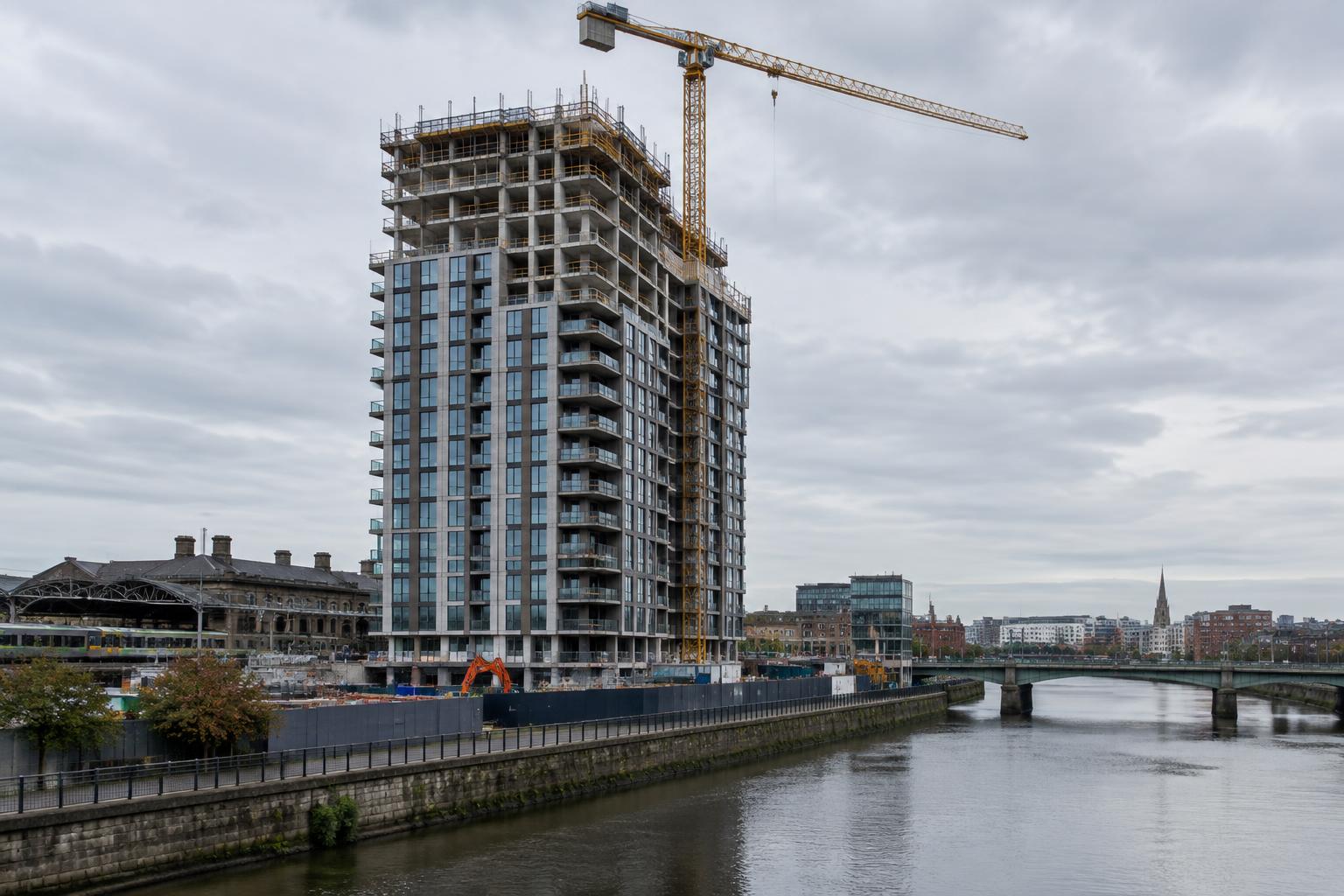
The Land Development Agency has confirmed that construction of 562 cost-rental homes at Parkgate Street, beside Heuston Station, will start in the coming weeks — turning a Dublin City Council planning permission into a major city-centre housing build.
What Has Been Announced
On 11 September 2026 the Land Development Agency (LDA) announced that work will soon start on 562 new homes at Parkgate Street, Dublin 8. The LDA is partnering with homebuilder Castlethorn on the scheme, and John Paul Construction is lined up as lead contractor. The build cost has been reported at close to €220 million.
Dublin City Council granted planning permission for the development last year. That permission is now turning into a construction site, with completion projected for 2029.
Every one of the 562 apartments will be owned by the LDA and let as cost-rental homes. Dublin People and Dublin Live both reported that the scheme's tallest block is set to become Ireland's tallest building when finished.
Why the Location Works
Parkgate Street sits across the Liffey from Heuston Station and next to the Phoenix Park. Mainline rail, the Luas red line and several bus routes are all within a short walk. That means residents can get to work in the city centre without needing a car.
The site was underused for years. Building homes on land that already has roads, water and transport close by is quicker and cheaper for the State than servicing new greenfield land on the edge of the city.
Housing Minister James Browne said it is "critical to see these much-needed new homes for Dublin progressing and located in the heart of the city".
How Cost Rental Works for Tenants
Cost-rental rents are based on what it costs to build, finance and run the homes, not on what the open market will pay. In practice, that usually means rents well below local market levels.
Tenants also get long-term security. The LDA's job is to hold the homes for the long run, so tenants aren't worried about a landlord selling up.
Over the past two years cost rental has grown from a pilot into a regular part of housing supply. The LDA, approved housing bodies and councils are all now delivering it. Parkgate shows the model working at city-centre scale, not just in suburban estates.
How It Fits Dublin City Council's Wider Pipeline
Parkgate adds to Dublin City Council's own Home Building Programme. Announced in March 2026, it aims to deliver about 4,000 homes across more than 30 city sites over four years.
Add in partnership schemes such as Oscar Traynor Woods in Coolock, which is now selling its final phase, and the capital has homes coming through in social, affordable purchase and cost-rental tenures at the same time.
Planning is the stage people rarely see once the cranes go up, but it is where every scheme starts. A permission granted in 2025 becoming a construction site in 2026 is the kind of progress people waiting for homes need to see.
From Permission to a Working Neighbourhood
The next phase at Parkgate Street is about converting a highly visible city-centre site into a functioning construction programme. Mobilisation involves securing the site, arranging access for plant and materials, agreeing traffic management and sequencing work around a busy part of Dublin. Heuston Station, the Luas, bus services, the River Liffey and the Phoenix Park make the location attractive, but they also mean construction has to be carefully managed. Progress should now be judged through activity on site and the programme towards the projected 2029 completion, rather than through another planning announcement.
The public ownership model gives the development a purpose beyond adding apartments to a headline supply figure. The LDA is due to retain all 562 homes for cost rental, so the apartments are intended to remain part of a long-term rental stock. That distinguishes the scheme from a conventional private development where individual units can be sold separately. It also gives future tenants a single institutional landlord and a rent model based on the cost of providing and managing the homes rather than the highest price available in the surrounding market.
Parkgate will also test how well high-density housing can be integrated into an established part of the city. Residents will need convenient entrances, safe walking routes, reliable building management and usable shared areas, not simply proximity to transport on a map. The final height will attract attention, including the reported claim about Ireland's tallest building, but the lasting measure will be how the ground level connects with Parkgate Street and how well the homes serve households over time. Those details will become clearer as construction moves from enabling work into the main build.
The LDA describes the development as four interconnected apartment blocks. Its published project information says the three lower blocks will range from ten to 13 storeys, while the 30-storey Parkgate Pointe element will contain 198 apartments. The homes are planned to achieve A-rated energy performance, and the scheme includes a landscaped communal courtyard, roof terraces, resident amenities and retail space. Those elements matter in a high-density development because the quality of shared space and building management will shape daily life as much as the view or address.
Local-authority housing delivery is a chain rather than a single announcement. Land has to be identified, funding approved, designs completed, planning secured, contractors appointed and the finished homes allocated or sold under published rules. A scheme can therefore appear quiet for long periods even while technical work continues behind the scenes. The useful test is whether it has crossed a measurable delivery point: a signed contract, work on site, applications opening or keys being handed over. That is why the stage reached in this project matters more than a broad promise about future supply.
The tenure is important too. Social housing gives households on a council list a secure home linked to need. Starter Homes help eligible purchasers bridge the gap between their mortgage capacity and the market price, with the council retaining an equity share. Cost rental serves households who may not qualify for social housing but cannot comfortably meet private rents. Delivering those options together allows councils and their partners to serve different incomes without treating every housing problem as if it had the same answer.
For residents, quality is measured over decades. Energy performance affects monthly bills; accessible layouts determine whether somebody can remain at home as their needs change; and proximity to schools, shops, healthcare and public transport shapes daily life. The number of homes is the headline, but location, tenure and long-term management decide whether a development becomes a settled neighbourhood. Those are the practical details to watch as each scheme moves from an official announcement to occupied homes.
The Bottom Line
Parkgate Street shows that large, well-located, publicly owned rental housing is going ahead in Dublin. The council permission is in place, a partner and contractor are appointed, and construction is weeks away. By the end of the decade, 562 households should have secure cost-rental homes beside Heuston Station.