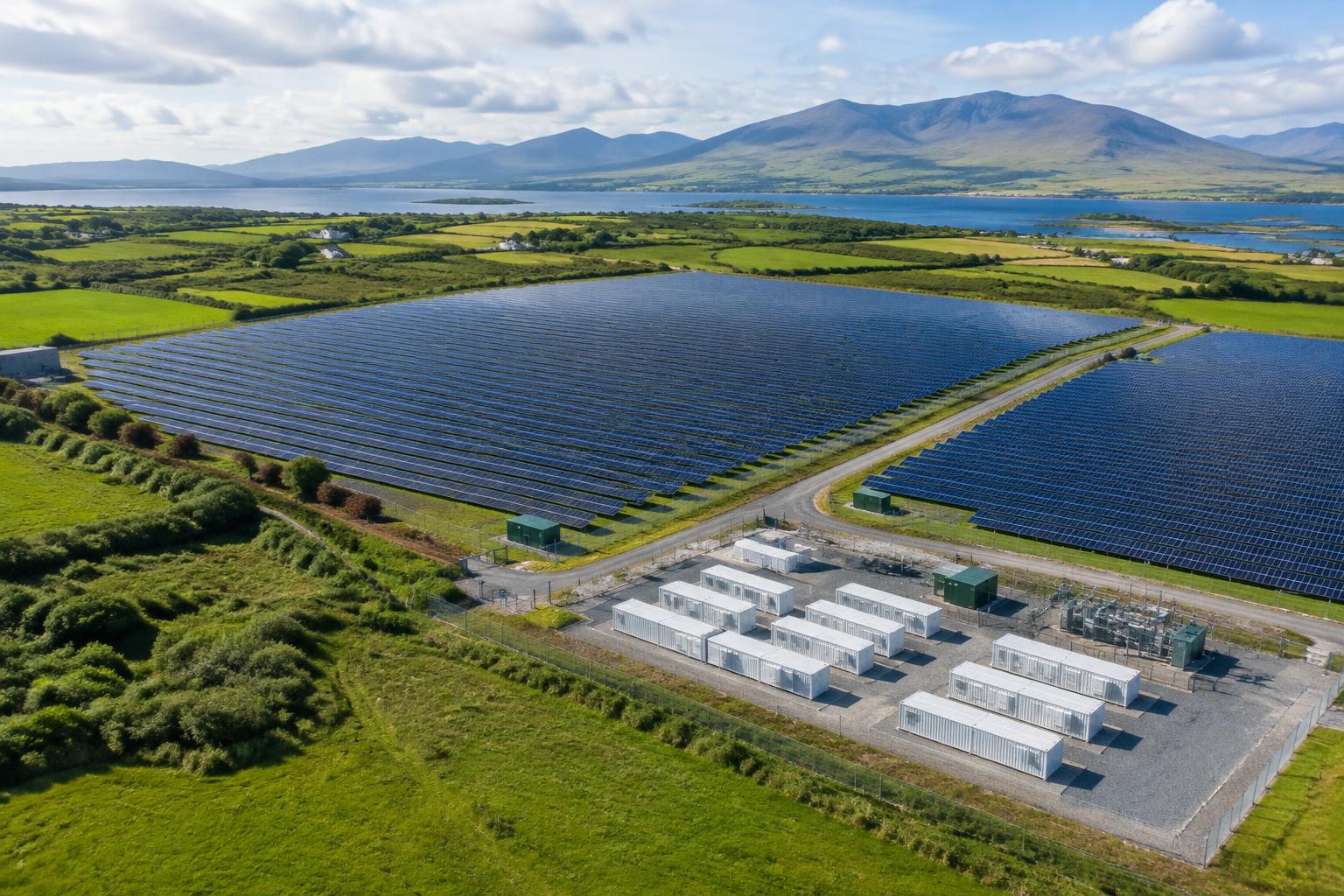
Kerry County Council has granted ten-year planning permission for a 57-hectare solar farm and battery storage facility outside Milltown, adding more renewable power to the county's supply.
The Decision
The application by Laurel Ridge Solar Farm Ltd covers a 57-hectare site across the townlands of Ballyoughtragh South, Commons, Farranmanagh, Knocknaman and Lisheennashingane near Milltown.
Kerry County Council granted permission for ten years, giving the developer time to secure a grid connection, finance and contractors.
Ten-year permissions are common for energy projects, which often depend on grid connection offers and national auctions before they can be built.
Solar Plus Storage
Pairing solar panels with batteries means power generated during the day can be stored and released in the evening, when household demand is highest.
That makes renewable power more useful to the grid and cuts the need for fossil-fuel generation at peak times.
Battery storage also helps keep the grid stable as more wind and solar power comes online.
Part of a Wider Trend
Councils around the country dealt with solar applications this summer, from north County Dublin to Longford and east Cork, as Ireland works to add more renewable power.
Kerry already has a long history of wind energy, and solar adds variety to the county's renewable mix.
The Council's Role
Council planners look at the landscape, road access, drainage and local impacts of each project, and attach conditions to protect neighbours and the environment.
Solar farms can often share land with grazing sheep and biodiversity planting, so the land stays in productive use.
Their decisions shape where Ireland's renewable energy is generated, making councils key players in meeting climate targets.
What Permission Does — and Does Not — Mean
Kerry County Council's decision allows the project to advance subject to the conditions attached to the permission, but it does not guarantee construction. The developer must still secure the commercial and technical pieces, including grid access and finance. The ten-year permission recognises that large energy projects can spend considerable time in those stages. Residents should therefore distinguish the authorised development from an operating solar farm and look for later announcements on grid connection, investment and a construction programme.
The planning conditions are central to how the 57-hectare site will sit in the landscape. They can govern access, drainage, boundary treatment, construction hours, ecological protection and eventual restoration. Battery infrastructure brings its own design and safety requirements, while planting can reduce views and strengthen habitat if it is properly established and maintained. The public planning file provides the reliable record of what was approved; general descriptions of solar farming should not replace the site-specific requirements in that decision.
Combining generation and storage can make the site more flexible, but the actual operation will depend on its approved design and grid arrangements. Solar output rises during daylight, while demand often continues into the evening. Storage can shift some energy between those periods and provide grid services, although it does not remove seasonal variation or the need for a wider electricity system. Milltown's contribution should ultimately be measured through built capacity and operation, not through the size of the planning boundary alone.
The permission, granted in August, covers more than panels. Published project information describes 14 electrical transformer stations, 36 containerised energy-storage modules, a 38kV substation and an underground grid connection running towards the Oughtragh substation. The developer says the project could supply the equivalent annual electricity demand of up to 10,000 homes and support a community benefit fund of about €90,000 a year once operational. Those remain projected benefits until the development is financed, connected and built, but they provide concrete measures against which later delivery can be assessed.
The consent provides for a 40-year operating life if the development proceeds, so decommissioning and restoration are relevant from the beginning rather than matters for a distant future council. Planning conditions can require equipment to be removed and the land restored when generation ends. During operation, the promised community benefit fund would need transparent local governance so residents can see what it supports. These long-term obligations are part of the public value of the planning system: permission establishes not only what may be built, but how impacts are managed throughout construction, operation and eventual closure.
Local authorities influence the energy transition in several distinct roles. They retrofit their own housing and public buildings, assess planning applications for new generation, provide streets and sites for shared heat networks, and prepare county climate plans. Those decisions connect national targets with particular buildings and communities. The practical question is not simply how much renewable capacity Ireland wants, but where projects can be delivered responsibly, how local impacts are managed and whether households see warmer homes or more dependable energy as a result.
Every energy project also has a delivery sequence. Planning permission, where required, is only one step; grid capacity, finance, procurement and construction must follow. Retrofit programmes need surveys, designs, resident communication and suitably trained contractors. District heating needs anchor customers and pipe routes as well as a source of spare heat. Keeping those stages separate avoids presenting a proposal as a finished outcome, while still recognising genuine progress when a council awards a contract, grants permission or moves a programme into its next phase.
The strongest local projects combine lower emissions with an everyday benefit. Better insulation can reduce the amount of energy a tenant needs; solar and storage can add diverse generation to the grid; and district heating can reuse energy that would otherwise be lost. Councils are well placed to demonstrate those changes because they own substantial building portfolios and make decisions in public. Residents can then judge delivery through planning files, budgets, contracts and completed work rather than relying on distant national targets alone.
The Bottom Line
The approved solar farm and battery storage at Milltown will add clean power to Kerry's supply, and it shows a council helping the move to renewable energy happen locally.