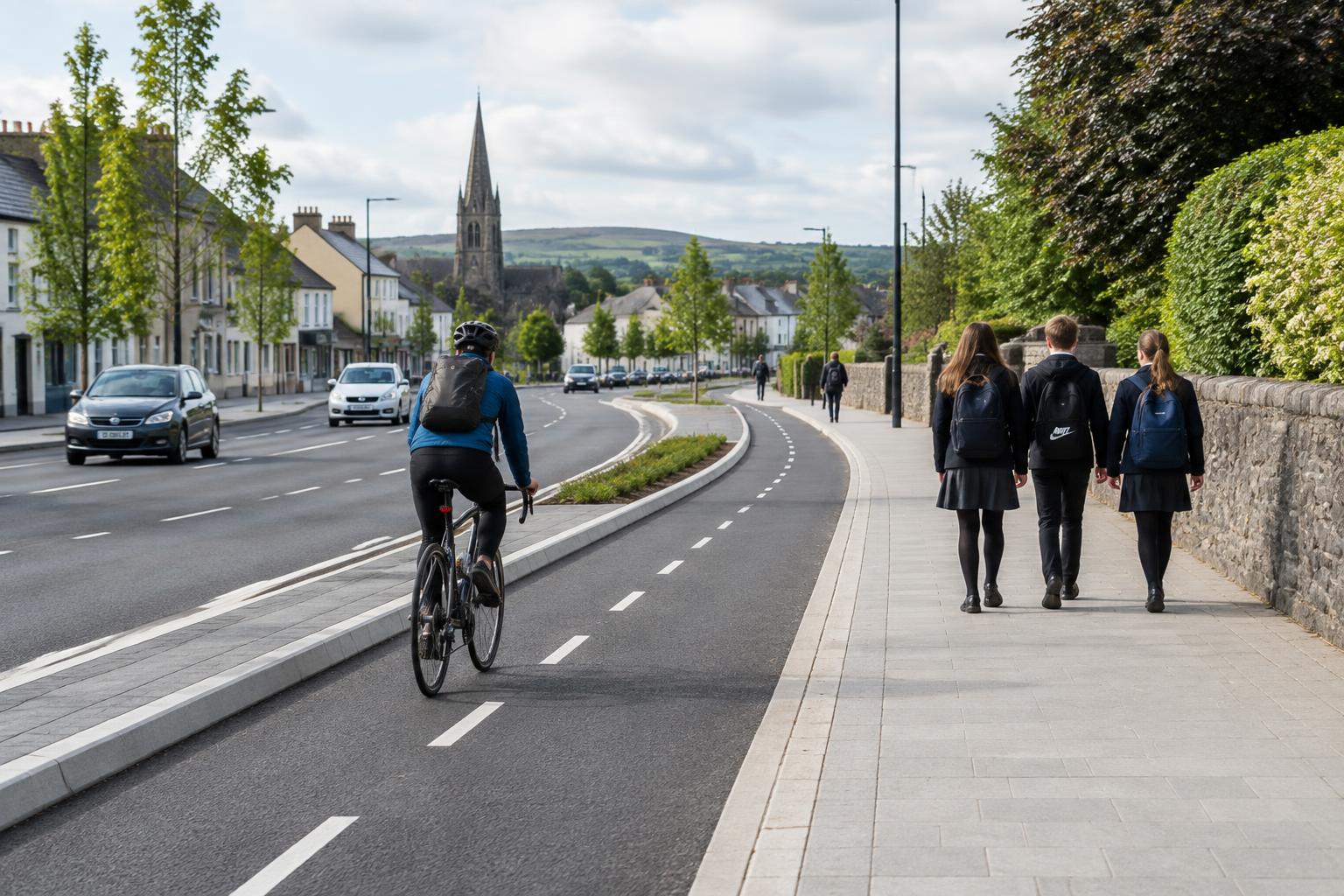
Longford County Council has started building a walking and cycling route to a Ballymahon school, Westmeath's Athlone to Ballinahown greenway is nearly complete, and Offaly is planning the next link to Banagher.
Ballymahon's R392 Scheme
Longford County Council appointed Tower Civil Engineering Ltd of Tullamore to build the R392 Ballymahon Pedestrian and Cycle Scheme, with work starting on 18 August.
The scheme adds about 350m of new walking and cycling infrastructure along the Ballymahon to Lanesborough Road, from the Moigh Road junction to St Matthew's National School.
It gives children a safer way to walk or cycle to school, and gives parents the confidence to let them. Fewer cars at the school gate also make the area safer for everyone.
Athlone to Ballinahown
The Westmeath Examiner reported in August that the Athlone to Ballinahown greenway is nearly finished.
Westmeath County Council also granted planning approval for a 1.3km greenway in Ballinahown. It will connect the village and its sports park to the Bord na Móna greenway corridor, part of the wider Athlone to Clonmacnoise route.
When complete, the route will link Athlone with the monastic site at Clonmacnoise, a combination of heritage and outdoor activity that suits both locals and visitors.
Offaly Looks to Banagher
Offaly County Council is hiring engineering consultants to assess extending the greenway from Shannon Harbour to Banagher.
That would give the route a finishing point in a town with cafés, pubs and accommodation, along with better links to the Grand Canal Greenway and the national cycle network.
Funded Nationally, Built Locally
These projects are part of a national programme backed by €360 million in Government funding for active travel and greenways in 2026, delivered through councils and Transport Infrastructure Ireland.
Councils do the local work of design, public consultation, planning and construction, which is why progress happens one town at a time.
Over time, these local links join up into a connected midlands network of safe walking and cycling routes.
Building a Network One Link at a Time
The Ballymahon section is short in distance but direct in purpose: it connects a junction with a national school along a route children and families already use. That makes day-to-day safety the immediate measure of success. The design must provide continuous space, safe crossings and clear treatment at entrances rather than leaving users exposed at the points where conflicts occur. Construction communication is also important because temporary works near a school can create the very congestion the finished route is intended to reduce.
The Athlone, Ballinahown and possible Banagher links operate at a different scale. Their value grows as individual sections connect villages, sports grounds, heritage sites and existing greenways. A route that ends abruptly may still serve local trips, but a continuous network attracts more everyday use and supports visitors staying longer. Offaly's consultant study is therefore an early but necessary step: it must test route options, environmental constraints, land requirements and cost before a preferred extension can advance.
National funding provides the opportunity, while councils determine whether the route works locally. Consultation with residents, landowners, schools, disability groups and businesses can identify access needs that are difficult to see on a drawing. Maintenance must be planned too, including surfaces, drainage, vegetation and signs. The strongest outcome is not kilometres announced but a route that people of different ages can use confidently for school, work, exercise and local trips throughout the year.
The Ballymahon contract is valued at €1.4 million and is funded through the National Transport Authority's Active Travel Programme. Its design includes two raised zebra crossings, school-zone treatments at St Matthew's National School and Ballymahon Vocational School, and the placing of overhead electricity lines underground. Construction is expected to take about ten months. In Westmeath, the separate seven-kilometre Bord na Móna trail towards Ballinahown was reported as substantially complete, while the approved 1.3km village connection will link the sports park with that wider corridor.
Council infrastructure projects move through a series of public stages: options and surveys, preliminary design, environmental assessment, planning or statutory approval, detailed design, land agreements, procurement and construction. Funding must often be confirmed again as a project passes from one stage to the next. That can make progress appear slow, but each completed stage reduces uncertainty and brings a project closer to work on the ground. Clear timelines are valuable, provided they remain tied to the approvals and procurement steps that still have to be completed.
The local benefit is usually wider than the piece of infrastructure itself. A road can unlock zoned land and make a town centre safer; a water upgrade can allow approved housing to connect; and a walking route can link homes with schools, shops and public transport. Councils therefore have to judge projects as part of a place rather than as isolated engineering works. The strongest schemes solve an immediate capacity or safety problem while supporting housing, local business and healthier travel over the longer term.
Delivery also depends on coordination that residents rarely see. Local authorities work with national agencies, utility companies, landowners, consultants and contractors, while maintaining access for homes and businesses during construction. Public consultation and environmental assessment are not side issues: they identify problems early and help shape a design that can be built and maintained. The next meaningful update is not another statement of ambition, but evidence that the project has advanced to its following formal stage.
The Bottom Line
A safer route to school in Ballymahon, a nearly finished greenway in Westmeath and plans for Banagher show the midlands walking and cycling network growing piece by piece.