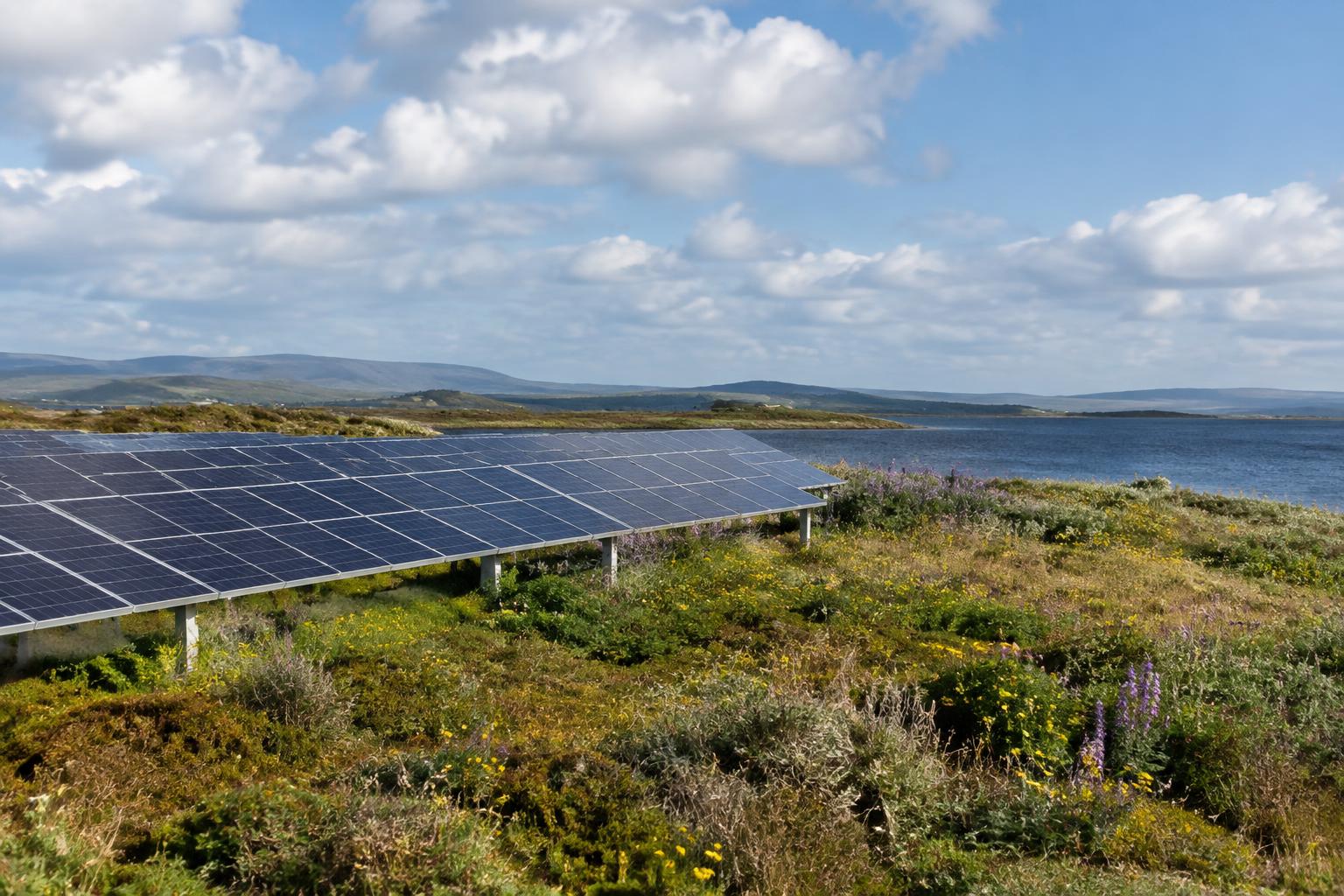
Renewable energy developer BNRG is in talks with Longford County Council about a large solar farm near Lanesborough that could power more than 18,000 homes, a new energy role for a town long linked with peat-fired power.
The Proposal
BNRG is holding early talks with Longford County Council about the solar farm near Lanesborough.
The developer plans to use low-lying panels and natural planting to limit the visual impact on the landscape.
If planning permission is granted, construction could start in 2028, with the solar farm running by 2029.
A New Energy Role for Lanesborough
For decades, Lanesborough was known for the Lough Ree power station and the Bord na Móna peat industry that supplied it.
A solar farm would give the area a new part to play in Ireland's energy supply, using the same skills, grid connections and energy know-how in a low-carbon way.
It also fits the wider Just Transition work in the midlands, which supports communities moving on from peat.
Talking Early
Talks with the council before a formal planning application let developers adjust their designs to address local concerns at the start.
That usually leads to better projects and smoother planning decisions, with the community involved from the beginning.
Across the Country
Lanesborough isn't alone. In north County Dublin, an 85-hectare solar farm at Shallon that could power 25,000 homes was also proposed this summer.
Kerry County Council approved a solar and battery project at Milltown in August, showing strong momentum for solar across local authority areas.
Testing the Proposal Before a Planning Application
Pre-application engagement is a chance to identify planning issues, not an indication that permission has been decided. Longford County Council can point the developer towards the development plan, environmental requirements and the information a formal application will need. The eventual application, if lodged, would then be available for public inspection and submissions. Keeping that distinction clear protects confidence in the process and allows the proposal to be discussed positively without treating its claimed timetable or output as certain.
The landscape and ecological design will be particularly important around a large rural site. Low panels and boundary planting may reduce views, but surveys must establish effects on habitats, water, archaeology, roads and nearby properties. Construction traffic and the grid connection can have impacts beyond the panel area itself. Those details should be assessed through submitted drawings and reports, with mitigation tied to any permission. General commitments made during early discussion will only become enforceable when reflected in the formal proposal and conditions.
Lanesborough's energy history gives the idea a strong local context, but a solar farm is not a direct replacement for every job or function associated with peat generation. Its value should be assessed on its own terms: investment, construction activity, renewable output, land management and any community benefit arrangements eventually proposed. The estimate that it could power more than 18,000 homes remains a developer projection. The next milestone is a complete planning application that allows the council and community to test that case with evidence.
The proposal had moved beyond early talks by the time it was reported: a formal application for the Carrowroe Solar Farm was lodged with Longford County Council on 19 August 2026. Published details describe a project of about 121MW across a 98-hectare site south of Lanesborough. The developer estimates generation equivalent to the annual use of roughly 18,400 households and carbon savings of about 28,000 tonnes a year. Those are application-stage projections and remain subject to the council's assessment, public participation, conditions and any later grid and investment decisions.
A second solar project already under construction north of Lanesborough provides useful context for the proposed Carrowroe development. ESB's Middleton House Solar Farm covers a separate site and is expected to generate electricity equivalent to the needs of more than 15,000 homes. The two schemes should not be combined or treated as one commitment, but together they show why grid planning and cumulative environmental assessment matter in the area. Longford County Council's consideration of Carrowroe must remain specific to that application while taking account of the wider pattern of energy development around the town.
Local authorities influence the energy transition in several distinct roles. They retrofit their own housing and public buildings, assess planning applications for new generation, provide streets and sites for shared heat networks, and prepare county climate plans. Those decisions connect national targets with particular buildings and communities. The practical question is not simply how much renewable capacity Ireland wants, but where projects can be delivered responsibly, how local impacts are managed and whether households see warmer homes or more dependable energy as a result.
Every energy project also has a delivery sequence. Planning permission, where required, is only one step; grid capacity, finance, procurement and construction must follow. Retrofit programmes need surveys, designs, resident communication and suitably trained contractors. District heating needs anchor customers and pipe routes as well as a source of spare heat. Keeping those stages separate avoids presenting a proposal as a finished outcome, while still recognising genuine progress when a council awards a contract, grants permission or moves a programme into its next phase.
The strongest local projects combine lower emissions with an everyday benefit. Better insulation can reduce the amount of energy a tenant needs; solar and storage can add diverse generation to the grid; and district heating can reuse energy that would otherwise be lost. Councils are well placed to demonstrate those changes because they own substantial building portfolios and make decisions in public. Residents can then judge delivery through planning files, budgets, contracts and completed work rather than relying on distant national targets alone.
The Bottom Line
Lanesborough could be producing clean power for 18,000 homes by 2029, a new chapter for a midlands town with a long history in power generation.