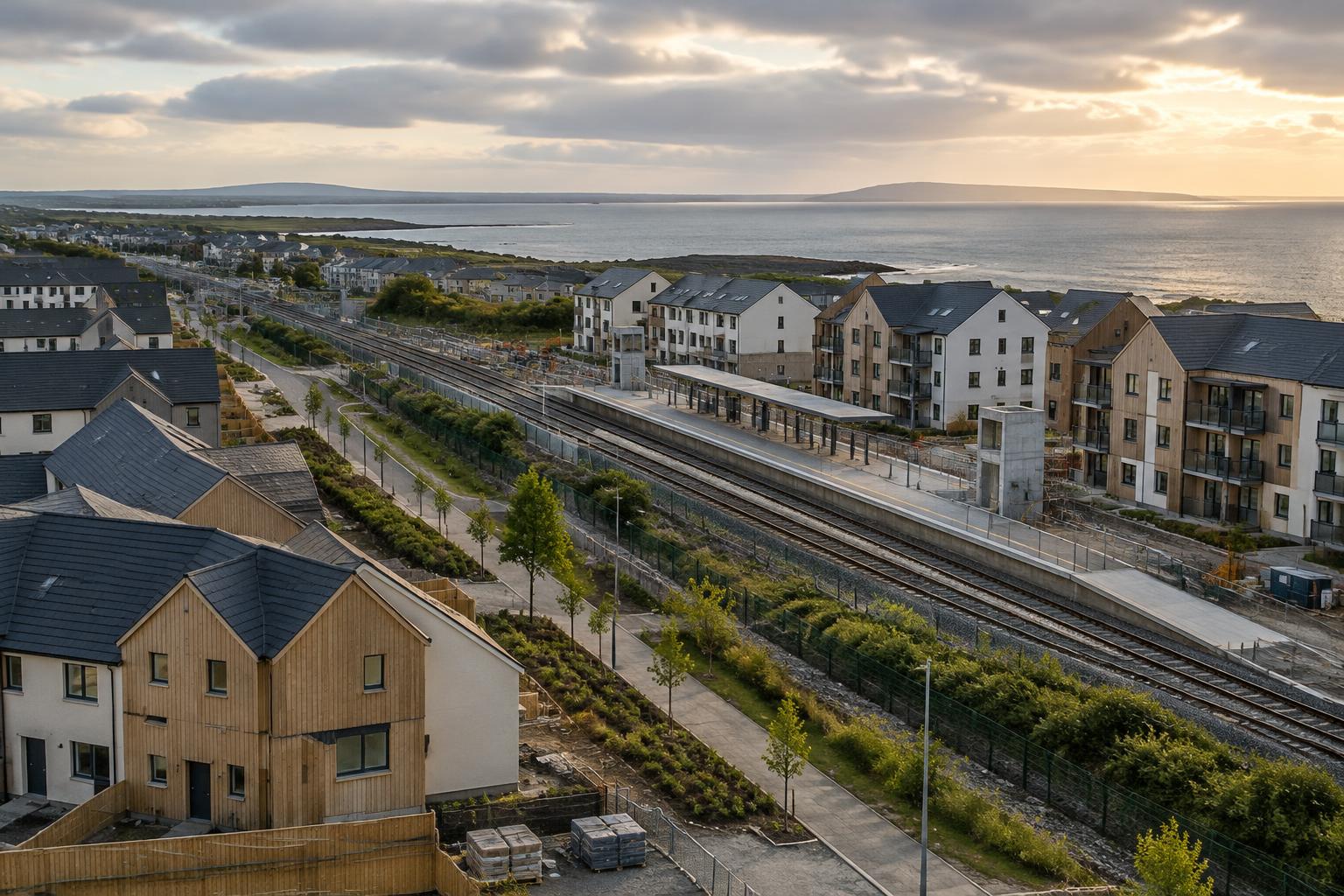
Galway City Council has published a draft urban design vision for the Murrough Lands proposing up to 2,500 new homes and a proposed new rail station on the city’s eastern coast. Public consultation is open, the rezoning is progressing through the City Development Plan, and the council’s 2026 budget has named Murrough a priority local area plan. Alongside a citywide programme of 2,440 social and affordable homes and the ongoing redevelopment of Ceannt Station, the vision sets out how Galway intends to grow in a connected and orderly way. Here is what is in train.
A City Ready for Its Next Phase
Galway is a city that has long punched above its weight. With a population of 84,414 — up 7.3% since 2016 — it is Ireland's fifth largest city, home to a major university, a thriving tech and medtech sector, one of the country's most visited tourism destinations, and a cultural life that draws people from across Ireland and abroad. Now, a series of planning decisions and investment commitments made in 2026 are positioning Galway for an urban expansion that would reshape the city's eastern edge, address its housing shortage directly, and connect new communities to the rail network in a way the city has never managed before.
The centrepiece is the Murrough Lands.
The Murrough Lands: A New Coastal Community
The Murrough area sits in the east of Galway City, close to Renmore, on land that includes the ATU-owned Murrough House and surrounding lands totalling approximately 34 to 35 acres. Galway City Council has published a draft urban design vision for the site proposing up to 2,500 new homes, with a rezoning from unzoned and recreation and amenity land to residential currently progressing through the City Development Plan process.
The vision is for a transport-oriented coastal community — new homes built alongside the infrastructure to serve them, with a proposed new rail station at the heart of the development. That last element is significant. Galway's rail connection to Dublin is one of its most important economic assets, but the city's rail infrastructure has historically served only those who can access Ceannt Station in the city centre. A new station within a large-scale residential development on the eastern edge of the city would give thousands of new residents direct rail access from their doorstep — a model of transit-oriented development that national planning policy has long supported.
The rezoning, backed by the council's 2026 budget which specifically identified the Murrough as one of the priority local area plan areas, is being driven by a recognition that Galway's housing need requires new land to be activated at scale. Fianna Fáil Councillor Alan Cheevers has described the Murrough development as "a big step forward for the east of the City" — and the combination of coastal location, rail access, and proximity to ATU and the city's established eastern residential communities makes it a site of clear strategic value for the west of Ireland.
Public consultation on the urban design vision is currently open. The Council has identified the site as capable of producing a genuinely mixed community, with the right infrastructure unlocking what the planning documents describe as a transport-oriented development of national significance.
The Rail Infrastructure Backing It Up
The proposed Murrough rail station does not exist in isolation. It sits within a broader programme of rail investment in Galway that is already under way.
Ceannt Station — Galway's main rail hub — is mid-transformation. Work began in early 2024 on a major redevelopment funded by the Department of Housing's Urban Regeneration and Development Fund and the National Transport Authority. The goal is to create an expanded, integrated transport hub with better rail and bus facilities, improved circulation, a Changing Places facility, and significantly reduced congestion on Station Road. The southern side of the station opened in April 2026, with further phases ongoing. The redevelopment is designed to allow significantly more rail frequency and capacity as services are expanded.
The Galway Metropolitan Area Transport Strategy, developed by the NTA, sets out a long-term vision for integrating rail, bus, and active travel across the city and its surrounding towns. Improved rail frequency, better rail-bus integration, and rail-based park-and-ride facilities are all identified as priorities. The NTA is also studying strategic rail and light rail opportunities for the city — work that the Murrough Lands development, with its proposed new station, feeds directly into.
Taken together, the Ceannt Station upgrade and the Murrough station proposal represent Galway beginning to build the rail infrastructure that a growing city of its ambition needs.
Housing Delivery: 2,440 Homes in the Pipeline
The Murrough Lands are the long-term play. Galway City Council is also delivering in the near term. Its Housing Delivery Action Plan targets 2,440 social and affordable homes across the city — 1,435 social homes and 1,005 affordable homes through purchase and cost rental schemes — with delivery through direct build, turnkey arrangements, and Part V acquisitions by the council and Approved Housing Bodies.
The 2026 budget specifically prioritised housing alongside upkeep of existing stock, tackling dereliction, and progressing local area plans for Ardaun, Murrough, and Castlegar — three areas identified as the city's next major development fronts. The Dyke Road development, a significant housing scheme in the city's west, is in active construction. The Ardaun area to the east of the city, adjacent to the Oranmore rail corridor, is identified as another key growth location under the city's development framework.
Galway City Council manages its housing programme alongside an active dereliction and vacancy agenda — the 2026 budget included specific funding for tackling vacant and derelict properties, bringing empty buildings back into use in areas where housing demand is high.
The Broader City Vision
The physical expansion of Galway's housing stock sits within a wider vision for the city that the council has been building out through its corporate strategy and annual budgets.
The Galway City Museum redevelopment is progressing — an investment in the cultural infrastructure of a city that draws significant cultural tourism and has a strong sense of its own identity and heritage. The Green Spaces Strategy is being implemented across the city's parks and open spaces. A new Retail Plan is being developed to support the city centre's commercial vitality. The Shopfront Enhancement scheme has been expanded, investing in the visual quality of Galway's streets.
The city's economic base is strong. Galway has established clusters in medtech, pharmaceuticals, ICT, and financial services, anchored by the presence of major multinationals alongside a growing indigenous tech and startup community. The University of Galway and ATU Galway produce graduates that feed directly into those sectors — and into the housing market that the council is now working to expand.
Thirty-one percent of Galway's working population works from home at least one day per week — a figure that both reflects the city's knowledge economy and underscores the importance of high-quality residential environments in retaining talent. People who work from home need homes worth working from. The Murrough Lands vision, with its coastal setting and transport links, is designed for exactly that population.
What 2,500 Homes on the Murrough Would Mean
The scale of the Murrough Lands proposal — up to 2,500 homes — would represent a significant addition to a city of 84,000 people. The vision is to create a new urban quarter on Galway's eastern coast, connected to the city by rail, served by the community infrastructure the council is building alongside it, and positioned to absorb a portion of the city's housing demand in a location that makes geographic and planning sense.
The rezoning process is progressing through the City Development Plan, with public consultation now open. The council's 2026 budget has named Murrough as a priority local area plan — the next formal planning stage that will define the site's development parameters in detail. The transport-oriented approach, with a proposed new rail station, reflects a planning philosophy that has been endorsed by the NTA and by national housing policy as the right way to deliver large-scale residential development.
Galway has the land, the rail corridor, the population growth, and the planning framework. The Murrough Lands are the site where all of those conditions come together in one place.
The Bottom Line
Galway City Council is advancing a major urban expansion plan for the west of Ireland. Up to 2,500 new homes on the Murrough Lands, anchored by a proposed new rail station and sitting within a broader programme of 2,440 social and affordable homes citywide, positions Galway to grow in a way that is connected, sustainable, and in keeping with the city's character. The rail investment at Ceannt Station, the local area plans progressing at Ardaun and Castlegar, and the cultural and civic investment running alongside the housing programme all point in the same direction. Galway is building for its future — and the Murrough is where that future takes shape.