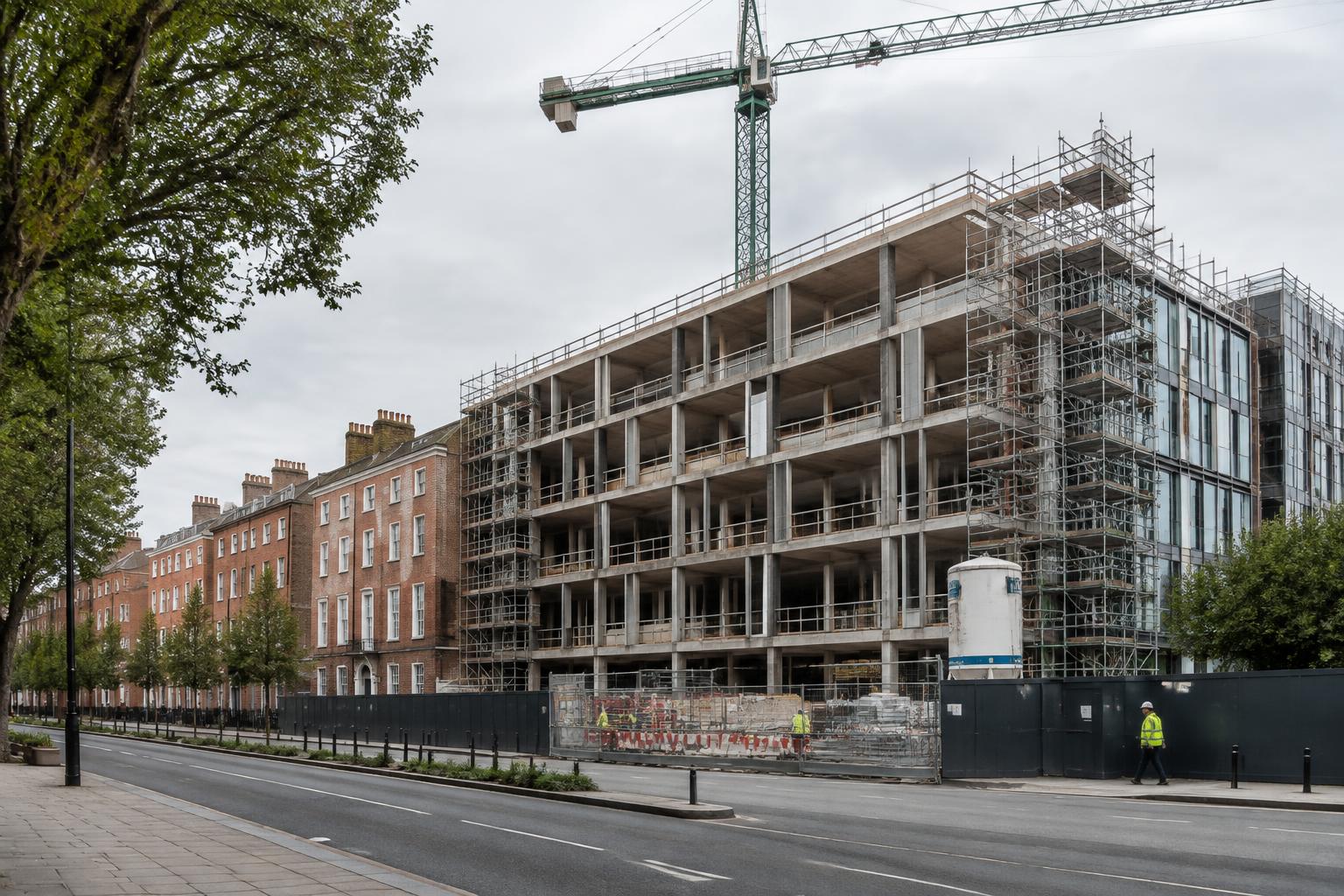
Four of Ireland's biggest local authorities are spending real money, on real projects, right now. Dublin City, Fingal, Galway and Cork are simultaneously executing capital programmes of a scale that would have been unthinkable a decade ago. Here is how they compare — and what it means.
Fingal: €730 Million on Site and Counting
Start with the numbers, because they are extraordinary. Fingal County Council currently has 121 capital projects on site simultaneously, worth a combined €730 million. It spent €563 million on capital delivery in the past twelve months — up 30% on the previous year. It has just approved a three-year capital programme of €1.43 billion covering 309 projects across seven departments.
For the fastest-growing county in Ireland — population up 23% between 2006 and 2016, and still accelerating — the scale of the programme reflects demographic reality. Fingal's projected population of between 327,000 and 333,000 by 2026 means communities are being built from the ground up across Donabate, Swords, Mulhuddart, Rush, Lusk, Skerries and Balbriggan simultaneously.
Housing takes nearly two thirds of the €1.43 billion programme — €884 million — with €259 million earmarked for direct social home building, €259 million for Part V acquisitions, and €6 million for compulsory purchase of vacant properties. Mixed-tenure schemes at Church Fields, Ballymastone, Mooretown and Hayestown are on site now. Ballymastone alone runs to over €60 million across two phases.
But Fingal is not just building houses. Culture House Fingal — a €34 million cultural quarter beside Swords Castle — is within days of its construction programme and expected to complete by end of 2026. New libraries are under construction in Skerries and Donabate. The Broadmeadow Greenway is progressing. The Ongar to Barnhill Link Road will open housing lands south of Hansfield station. And a proposed €58 million district heating scheme in Blanchardstown — capturing waste heat from local data centres to heat homes — is in detailed design with a national funding application being prepared.
Mayor Tom O'Leary: "Record figures in terms of projects and money spent shows that Fingal is stepping up to the plate." CEO AnnMarie Farrelly: the council must provide "the facilities and supports which will allow our new communities to grow in a sustainable way."
Grants cover 79% of the programme. The rest comes from development levies, the revenue budget, and loans.
Dublin City: A €173 Million Investment in the North Inner City
Dublin City Council's big story of 2026 is Parnell Square. Following the planning and development stages, construction has begun on the €173.2 million Parnell Square Cultural Quarter — with Purcell Construction appointed as main contractor and government backing of €105.14 million confirmed.
Phase 1 delivers a new five-storey City Library of over 6,100 square metres on Parnell Square North, replacing the ageing Central Library at the Ilac Centre after four decades. The Georgian terrace at Nos. 23–28 Parnell Square North will be fully conserved and restored. Improvements to the Hugh Lane Gallery's 1930s wing are included, along with a new internal link connecting the gallery to the new library through Charlemont House.
The project sits at the northern end of Dublin's Civic Spine and is designed to drive footfall, support local businesses and anchor the regeneration of the north inner city — bringing cultural investment into physical form and creating a new destination for residents, visitors and businesses.
Dublin is also developing its seasonal cultural offer: a bid to be named European Capital of Christmas, anchored by an expanded TwinkleTown at Smithfield and the Liberties, with new light projections across the city centre.
Galway: 2,500 Homes and a New Train Station
Galway City Council has published a draft urban design vision for the Murrough Lands proposing up to 2,500 new homes and a brand new rail station — one of the most significant land-use proposals the west of Ireland has seen in a generation. Public consultation is currently open.
The Murrough Lands sit at the edge of the city and have long been identified as a key development opportunity. The proposal responds to Galway's housing needs while reimagining how the city connects to its rail network. Bringing these priorities together offers a practical framework for a new neighbourhood with transport connections built into its design from the outset. A new rail station within a residential development of this scale would represent a genuine shift in how the city plans for transport alongside housing, rather than after it.
Separately, Galway City Council has approved the Part 8 planning process for a new tourist information centre and public facilities at Eyre Square — a modest project but one that signals continued investment in the city's civic infrastructure at its most visible public space.
The University of Galway and Galway City Museum also announced a strategic partnership this month on educational and cultural projects — a reminder that the city's ecosystem of institutions is developing alongside its physical infrastructure.
Cork: 5,671 Homes and a New Direction
Cork City Council is mid-execution on its most ambitious housing programme to date: 5,671 social and affordable homes targeted for delivery by end of 2026, comprising 3,934 social homes and 1,737 affordable homes. The greatest demand is for one-bedroom homes and specially adapted accommodation for older people and those with disabilities.
The programme spans the city's suburbs and centre, with 2,385 social homes in suburban locations, 318 in the city centre, and 325 in the Docklands — where the first affordable homes are now arriving as the State's regeneration of Cork's eastern waterfront begins to take physical shape.
Cork's new Chief Executive has set out an agenda that goes beyond housing delivery: docklands regeneration, light rail, and a cultural revival on South Main Street. A five-year city blueprint published earlier this year puts public transport and the docklands at the centre of Cork's next phase of growth, with light rail identified as the transformative infrastructure investment the city needs to function at the scale it is being planned for.
Cork's programme links ambitious housing targets with the practical resources needed to advance them. The council has identified further central government funding and additional staff capacity as necessary to meet its affordable housing targets. Setting out those requirements gives partners a clear basis for supporting delivery, from building and allocations to loans and maintenance. Alongside the first docklands homes, the wider programme sets a constructive direction for Cork's growth, with housing, transport and cultural investment planned as complementary parts of the city's development.
The Shared Direction
Taken together, the four programmes represent something genuinely notable in Irish local government: a moment of simultaneous, large-scale capital commitment across the country's major urban authorities.
Fingal has 121 projects on site, spanning housing and the facilities that support growing communities. Dublin City is moving its major cultural quarter into construction, linking a new library with heritage conservation and gallery improvements. Galway is consulting on a substantial new neighbourhood with a rail station at its heart. Cork's social and affordable housing targets set out a significant programme to expand access to homes across the city. Each authority is pursuing a distinct programme shaped by the needs of its residents.
The common thread is population pressure. Ireland's urban centres are growing, and the infrastructure backlog — housing, transport, cultural facilities, community services — is being addressed simultaneously rather than sequentially. Coordinating these strands means aligning funding, project teams and supporting services across successive phases. The shared focus on homes and community infrastructure gives the programmes a clear purpose and a positive sense of momentum.
Each programme follows a sequence from capital approval through planning, procurement, funding confirmation and construction. Understanding those stages helps residents distinguish projects already on site from proposals still being developed. As the programmes advance towards 2028 and 2030, individual milestones will show how investment is translating into homes, public spaces and services. That phased approach provides a practical way to follow progress without treating every proposal as an already completed commitment.
For now, the programmes combine active construction, funding commitments and proposals open to public input. Together, they demonstrate how councils are bringing long-term plans into the everyday work of building and supporting communities.
The Bottom Line
Dublin, Fingal, Galway and Cork are all building — at the same time, with real programmes and real funding behind them. Fingal has 121 projects on site worth €730 million. Dublin is constructing its €173 million north inner city cultural quarter. Galway is consulting on 2,500 homes and a new rail station. Cork is targeting 5,671 social and affordable homes. Together, these programmes show local authorities investing in the homes, connections and cultural facilities that growing communities need, with active projects and clear next steps supporting that shared direction.