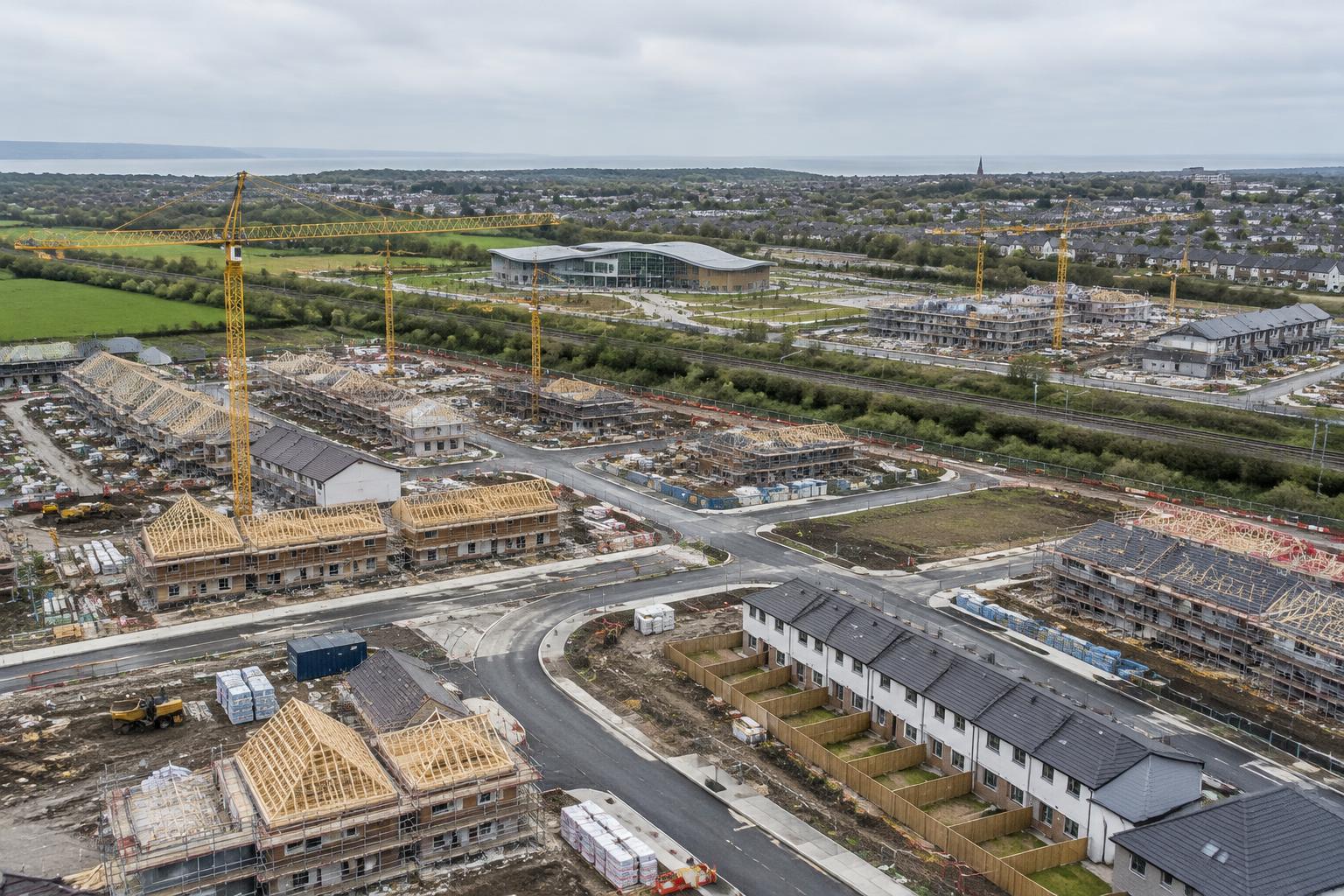
Fingal County Council has 121 capital projects worth €730 million on site right now and a three-year programme of €1.43 billion covering 309 projects. Here is what is being built, how it is being funded, and how the programme supports growing communities.
A Different Kind of Housing Story
Fingal County Council's capital programme brings housing and community investment together in a visible way. Across north Dublin, construction is progressing on homes and the facilities that support everyday life, with active sites giving residents a practical view of how the county's development plans are taking shape. Right now, the fastest-growing county in Ireland has 121 capital projects on site simultaneously, worth a combined €730 million. It has just approved a three-year capital programme totalling €1.43 billion covering 309 projects across seven departments. And it is planning to spend €540 million in 2026 alone.
For context: that is more capital investment than many European cities of comparable size manage in a decade.
Fingal's Chief Executive AnnMarie Farrelly put it plainly at the council's October monthly meeting: the scale of what is being built reflects not just a housing imperative but a responsibility to ensure "the facilities and supports which will allow our new communities to grow in a sustainable way." Mayor Tom O'Leary was more direct: "record figures in terms of projects and money spent shows that Fingal is stepping up to the plate."
Those priorities connect the programme's scale with its purpose: providing homes and the services that help communities thrive.
The Scale of What Is on Site Right Now
The 121 projects currently under construction represent a 30% increase on the same point last year, when 111 projects worth €574 million were active. The pace of delivery has accelerated sharply: Fingal spent €563 million on capital projects in the past twelve months, up from €431 million in 2024.
Sixteen of those 121 projects, each individually worth more than €5 million, account for €651 million of the €730 million total. That concentration of large-scale investment in a single county council's pipeline is remarkable by any measure of Irish local government.
The housing programme accounts for the lion's share of activity. Mixed-tenure developments are under construction at Church Fields in Mulhuddart, Ballymastone in Donabate, Mooretown in Swords, and Hayestown in Rush. Social housing schemes are active at Holywell, Seatown Road, and North Street in Swords, at Mourneview in Skerries, and at Remount in Lusk. The first phase of Mooretown's social housing alone is costed at €43 million. Ballymastone spans two phases at a combined cost of over €60 million.
Why Housing Is the Dominant Priority
The housing programme's scale makes sense when you understand Fingal's demographic trajectory. The county has been the fastest-growing local authority in Ireland for two consecutive census periods. Its population stood at 296,000 in 2016 and was projected to reach between 327,000 and 333,000 by 2026 — a growth rate running at more than double the national average. The communities being built out across north Dublin — Donabate, Swords, Balbriggan, Mulhuddart, Rush, Lusk, Skerries — are not abstract planning designations. They are places where tens of thousands of people already live and where tens of thousands more are arriving.
Of the €1.43 billion three-year programme, €884 million — nearly two thirds — is allocated to housing. Within that, €259 million is earmarked for building social homes directly, a further €259 million for acquiring homes in private developments under Part V for use as social housing, and approximately €6 million for compulsory purchase of vacant dwellings. That last figure is modest in isolation but signals a willingness to use every available tool to bring empty homes back into use.
Beyond Housing: Infrastructure for Communities
What distinguishes Fingal's programme from a pure housing delivery operation is the breadth of what is being built alongside the homes. Libraries, recreation, transport and cultural facilities are being planned alongside housing, supporting neighbourhoods where people can live, meet, learn and spend time together. That combination gives the programme a clear community focus.
Culture House Fingal, the centrepiece of the Swords Cultural Quarter beside Swords Castle, is a €34 million investment in the cultural identity of a town that will shortly become one of the largest urban centres in Ireland. The project is reported to be within a day or two of its construction programme and is expected to be substantially complete by the end of 2026. New libraries are under construction in Skerries and Donabate. Baldoyle Community Centre is on site. The Ballymastone Recreational Hub will serve the large new communities being built around Donabate.
On transport, the Broadmeadow Greenway is progressing — a greenway connecting communities along the north Dublin coast. The Ongar to Barnhill Link Road will open up housing lands south of Hansfield railway station for development, a critical piece of infrastructure enabling the next wave of residential delivery. Together, these transport investments expand the options for travelling between homes, services and neighbouring communities. Connecting new housing with walking, cycling and public transport supports both existing residents and the people moving into the county's growing neighbourhoods.
One project worth watching is the district heating scheme for Blanchardstown. Fingal has committed €1.9 million for detailed design and a national funding application, with an overall estimated project cost of €58 million. The concept — capturing waste heat from the data centres that have proliferated across north Dublin and redirecting it to heat homes — is the kind of infrastructure innovation that could fundamentally change how new communities in the county are powered. The full scheme would be a joint venture, and if the national funding application succeeds, Blanchardstown could become a model for district heating in Irish urban development.
Another important community investment is the Castlelands swimming pool near Balbriggan, where costs have risen from €10 million to €11 million. Design is expected within weeks, with planning permission through the council's own Part 8 process targeted before year-end. For a growing town such as Balbriggan, the pool would add a valuable local facility for recreation, swimming lessons and community activity, complementing the wider investment in homes and public services.
How It Is Being Funded
The programme brings together several funding sources to support its successive phases. Grants from central government and national agencies cover 79% of the capital programme — a figure that reflects both the quality of Fingal's grant applications and the political priority being attached to the county's development needs at a national level. Development levies contribute €159 million, the council's own revenue budget €43 million, and loans and other sources €34 million. A further €44 million worth of projects are still under assessment for funding confirmation.
Grant funding, which covers 79% of the programme, reflects the importance of partnerships with national and European funding bodies. The council reviews its capital programme annually, allowing the schedule to reflect confirmed allocations and the progress of individual projects. That process provides a practical framework for coordinating funding with delivery, while the mix of development levies, council resources and borrowing supports the wider investment plan.
What This Means
Fingal County Council is, by any reasonable measure, the most active local authority in Ireland in terms of capital delivery right now. The combination of population pressure, available land, a relatively young and growing tax base through development levies, and strong grant-capture performance has created conditions in which large-scale building is not just possible but necessary.
The programme's community investments are an important part of that growth. Libraries, parks, recreation, cultural facilities and transport connections help turn new housing into neighbourhoods with a shared sense of place. Fingal's active projects bring those priorities together, with facilities planned alongside residential development rather than treated as separate ambitions. As individual phases advance, this breadth of investment provides a framework for supporting both new households and established communities across the county.
For now, though, the numbers speak for themselves. €730 million on site. €1.43 billion in the pipeline. 309 projects. One county council. Stepping up to the plate.
The Bottom Line
Fingal County Council is operating at a scale of capital delivery that has no precedent in Irish local government. With 121 projects on site, a three-year pipeline of €1.43 billion, and housing at the centre of everything, the fastest-growing county in Ireland is making the physical infrastructure to match its population. The breadth of investment in libraries, recreation, culture and transport shows how the programme extends beyond housing numbers. By bringing homes and supporting facilities forward together, Fingal is shaping places where growing communities can build their everyday lives.