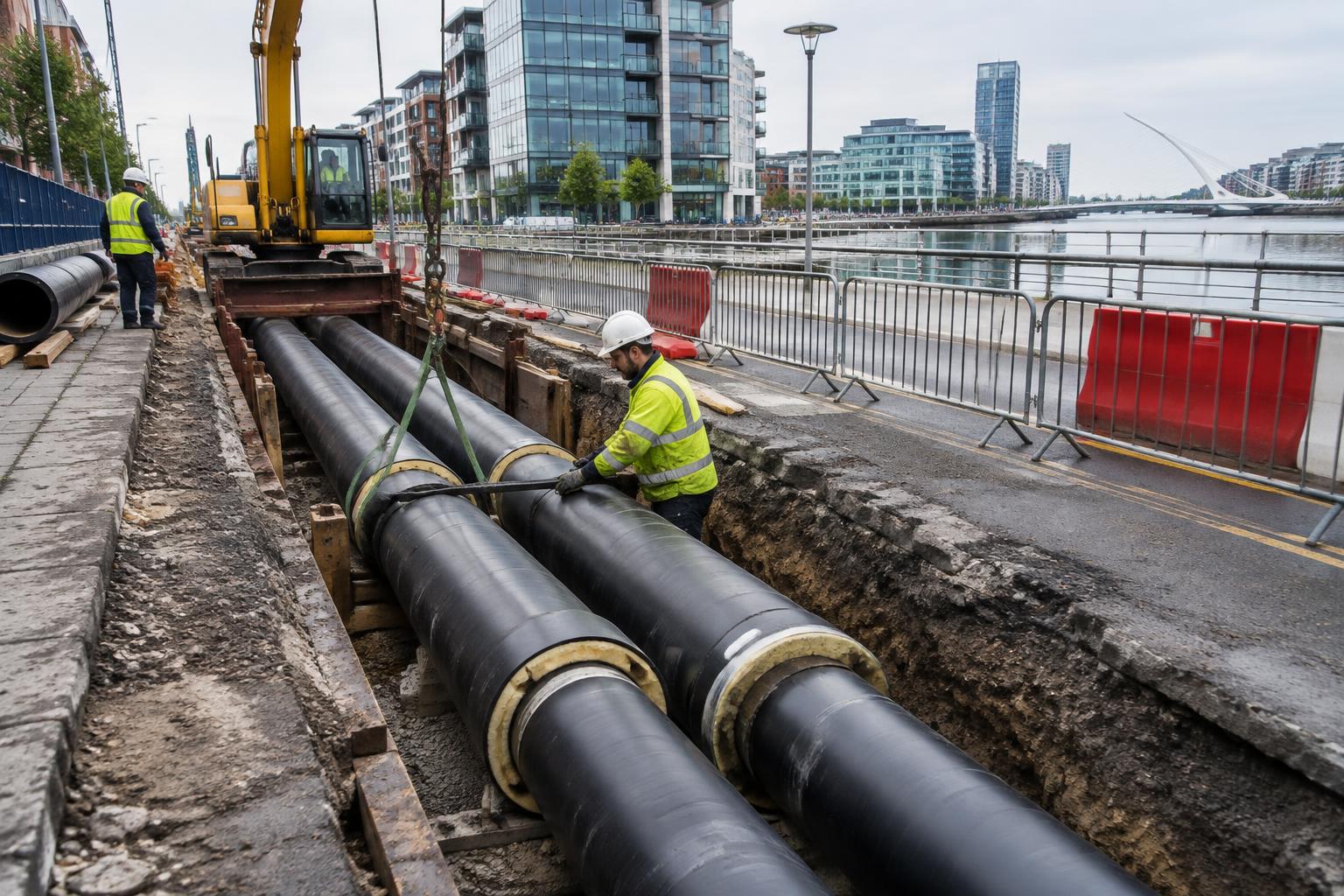
Dublin City Council is open to an early pilot connecting community buildings in Ringsend and Irishtown to the Dublin District Heating System, and a Blanchardstown data centre wants to pipe its spare heat to nearby buildings.
Ringsend First?
The Dublin District Heating System is designed to capture heat from the Poolbeg waste-to-energy plant and use it to heat water for local buildings.
In August the council's chief executive said the project team is "very happy" to consider an early pilot connection to community facilities around Ringsend and Irishtown, according to a report to the South East Area Committee.
A pilot would let the communities closest to Poolbeg be among the first to benefit from heat generated on their doorstep.
Blanchardstown Follows Tallaght's Lead
In Dublin 15, another data centre is looking to pipe hot water to heat nearby buildings.
South Dublin County Council's Tallaght District Heating Scheme already uses waste heat from a data centre to warm council buildings and the TU Dublin campus, so the approach has a working local example.
Data centres produce a steady supply of heat all year round, which makes them well suited to supplying district heating networks.
The Heat Bill
In August the Government advanced a new Heat Bill, to be introduced in the Oireachtas later this year. It is designed to make it easier to roll out district heating across the country, with clearer rules for developers, councils and customers.
Climate and Energy Minister Darragh O'Brien said research shows district heating could supply about 80% of Dublin's total heat demand by 2050.
Why Councils Matter Here
District heating replaces individual gas boilers with shared, lower-carbon heat piped in from a central source.
Councils are central to it because they own many of the buildings, streets and sites needed to lay the pipe networks. They can also connect their own buildings and housing as early customers.
For residents, district heating can mean steady, predictable heating costs without having to maintain a boiler.
From Available Heat to Connected Buildings
Waste heat only becomes useful when a network and dependable customers connect to it. The Poolbeg source, potential Ringsend and Irishtown buildings, pipe route, operating temperatures and commercial arrangements all have to work together. An early pilot could test those elements at manageable scale and give local facilities direct experience of the service. It should also establish evidence on costs, reliability and disruption before a wider network asks more homes and organisations to connect.
Tallaght provides an Irish example of the anchor-customer approach. Public buildings and a third-level campus give a network a stable starting demand, allowing additional connections to be considered as the system develops. A Blanchardstown proposal would still need its own engineering and agreements; proximity to a data centre does not by itself make heat recoverable at the right temperature or price. Early technical work must show who owns the equipment, who supplies customers and what happens if the original heat source changes.
The planned Heat Bill is relevant because district heating creates relationships that individual boilers do not. Customers need clear protections, pricing information and service standards, while developers and councils need rules for licensing, access and long-term operation. Streets may need to be opened for pipes and public buildings can become early users, putting local authorities at the centre of delivery. The next meaningful progress will be a defined pilot or project agreement with routes, customers, costs and responsibilities set out publicly.
Dublin City Council says the wider district-heating project is designed to recover up to 90MW of heat from the Dublin Waste to Energy facility. The Tallaght network offers a smaller operating comparison: it has used waste heat from an Amazon data centre since 2023 to serve public buildings and the local TU Dublin campus. By 2026 it had generated roughly 6,000MWh, while reported 2024 operation avoided about 1,265 tonnes of carbon dioxide. Those results do not guarantee the same outcome elsewhere, but they show the model operating within a Dublin council area.
Local authorities influence the energy transition in several distinct roles. They retrofit their own housing and public buildings, assess planning applications for new generation, provide streets and sites for shared heat networks, and prepare county climate plans. Those decisions connect national targets with particular buildings and communities. The practical question is not simply how much renewable capacity Ireland wants, but where projects can be delivered responsibly, how local impacts are managed and whether households see warmer homes or more dependable energy as a result.
Every energy project also has a delivery sequence. Planning permission, where required, is only one step; grid capacity, finance, procurement and construction must follow. Retrofit programmes need surveys, designs, resident communication and suitably trained contractors. District heating needs anchor customers and pipe routes as well as a source of spare heat. Keeping those stages separate avoids presenting a proposal as a finished outcome, while still recognising genuine progress when a council awards a contract, grants permission or moves a programme into its next phase.
The strongest local projects combine lower emissions with an everyday benefit. Better insulation can reduce the amount of energy a tenant needs; solar and storage can add diverse generation to the grid; and district heating can reuse energy that would otherwise be lost. Councils are well placed to demonstrate those changes because they own substantial building portfolios and make decisions in public. Residents can then judge delivery through planning files, budgets, contracts and completed work rather than relying on distant national targets alone.
The Bottom Line
From Poolbeg to Blanchardstown, Dublin's councils are working to turn spare heat into warm buildings, and new legislation is on the way to help district heating expand.