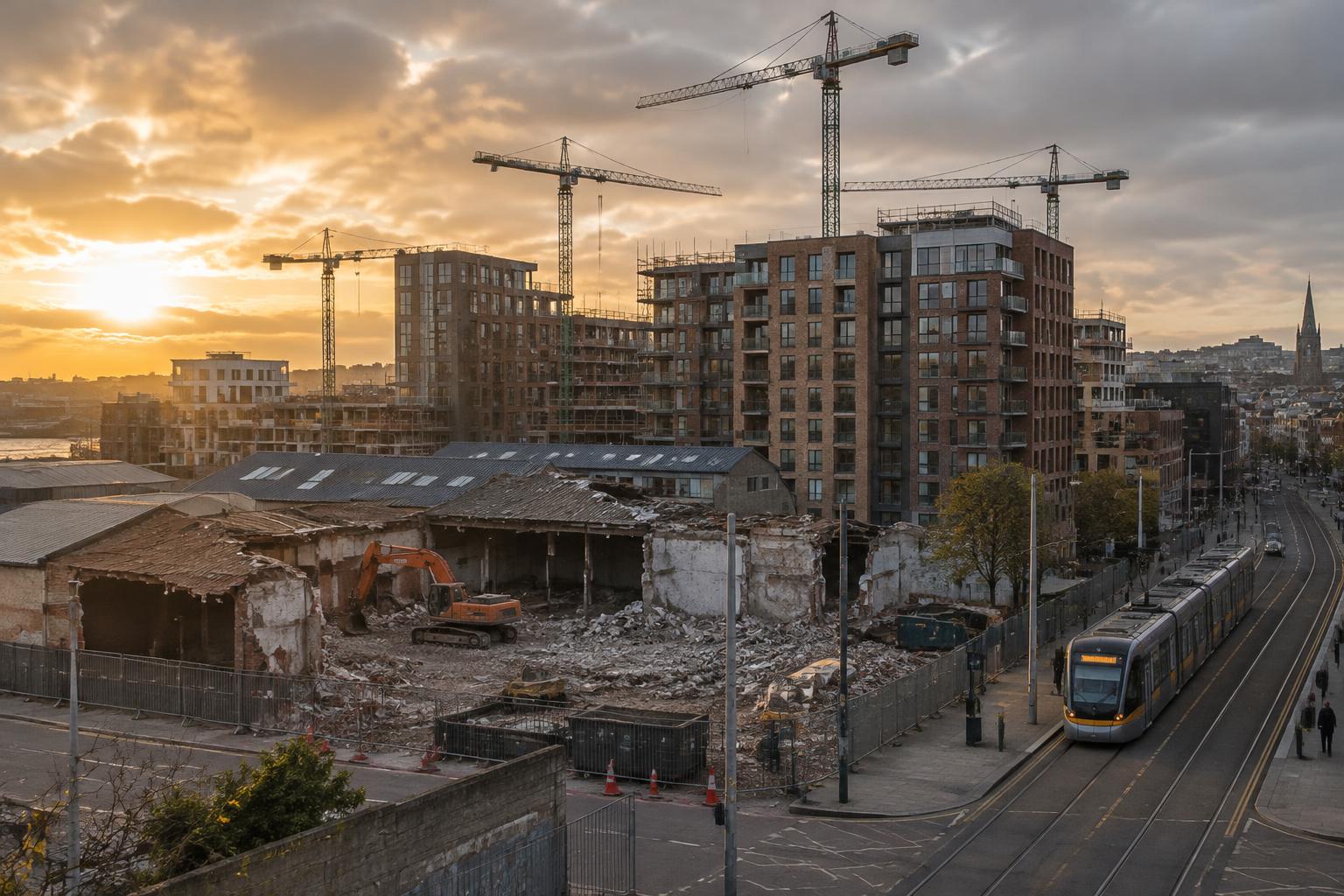
Dublin City Council has rezoned land across Glasnevin, Kylemore, Finglas, Santry and beyond for up to 25,000 new homes. Here is where they could go, what councillors built in for communities, and what it will take to turn more than 80,000 Dublin planning permissions into homes people can live in.
What Dublin City Council Actually Decided
Dublin City Council has put in place the land it needs for up to 25,000 additional homes across the city. At a Special Council Meeting on Monday 22 June 2026, councillors concluded a statutory process that began in October 2025, adopting Variation No. 11 of the Dublin City Development Plan 2022–2028 and approving a set of masterplans and site rezonings designed to enable housing growth up to 2032. The variation took effect the same night.
In plain terms, rezoning changes what a piece of land can be used for. Much of the land involved was previously zoned for employment and enterprise — business parks, industrial estates and retail sites. The new zoning opens it up for housing-led and mixed-use development, meaning homes can sit alongside shops, workplaces, schools and community facilities rather than being kept apart from them.
The council described the decision as a strategic response to the National Planning Framework's housing growth requirements, which ask every local authority in the country to zone enough land to meet rising population targets. Dublin City Council said the rezonings were designed to balance ambition with deliverability, so that growth is not only accommodated but shaped into sustainable, liveable and resilient communities.
Where the 25,000 Homes Could Go
The 25,000 figure is built from three distinct parts. The largest is Broombridge–Hamilton in Glasnevin. Its masterplan was approved for inclusion in the City Development Plan in January 2026 and creates a new Strategic Development and Regeneration Area with capacity for approximately 8,500 homes. It is already moving through the planning system, and it sits beside the Broombridge Luas and rail interchange — the kind of transport-led location that planners favour for higher-density living.
The second is City Edge in Kylemore, the large area between Inchicore and Ballyfermot. Its masterplan was finalised and approved on 22 June and provides for approximately 5,300 homes. City Edge has long been identified as one of the biggest regeneration opportunities on the western side of the city, with the potential to turn a landscape of warehouses and industrial units into a new urban neighbourhood.
The third part is a package that expands eight Strategic Growth Areas across the city and rezones seven key sites, together with the potential for up to 10,000 more homes. According to reporting from the meeting, the sites considered included lands at EastPoint Business Park and East Wall Road in Dublin 3, Finglas Business Park, Greenmount Industrial Estate in Harold's Cross, Fumbally Lane in Dublin 8, 7.1 hectares on the east side of North Road in Finglas, and the Shanowen lands in Santry.
Spreading the capacity across north, south and west of the city matters. It means new supply is not concentrated in a single district, and it gives more communities the chance to see homes delivered close to existing schools, shops and transport links.
Councillors Built In Community Safeguards
The meeting ran from 6.15pm to just after midnight, and the length of the debate reflected how seriously councillors took the detail. Rather than simply nodding the plans through, members used the process to strengthen them.
On the Shanowen lands in Santry, the leaders of seven groups and parties on the council jointly proposed an amendment requiring a framework plan with a set timeline. The aim is to make sure the lands meet local housing need while also providing for social, community, cultural and economic opportunities in the area. On North Road in Finglas, the debate focused on making sure transport keeps pace with growth, with the Luas Finglas extension — which received planning permission in October 2025 — central to the discussion.
Councillors also raised the importance of inclusive planning across the new masterplan areas, including accommodation for Traveller families. These debates are a healthy sign of local democracy at work: elected members asking not just how many homes can be built, but what kind of neighbourhoods those homes will create and what infrastructure must arrive alongside them.
The Delivery Question: From Permission to Construction
Rezoning is the first step, not the finish line. The real test is whether homes are built, and the most recent figures show exactly where the focus now needs to be. The Dublin Housing Supply Pipeline report for the second quarter of 2026, published by the Department of Housing in August, found that 80,285 homes had planning permission across the four Dublin local authorities. Of those, 33,623 — or 41.9 per cent — had been activated, made up of 10,097 completed homes and 23,526 under construction on 209 active sites.
That means fewer than half of the homes already permitted in the Dublin region have started. The gap is largely about apartments: more than 41,000 approved apartment units across Dublin had not commenced, according to the Banking and Payments Federation Ireland's Housing Market Monitor for Q2 2026. Building apartments is expensive, and viability — whether a scheme can be built and sold or rented at a price that works — remains the biggest hurdle.
There is genuinely encouraging news within those figures. Total permissions in Dublin rose 2.3 per cent year-on-year. In the Dublin City Council area alone, 29,612 homes have planning permission, and active permissions — homes built or under construction — rose 9.1 per cent year-on-year to 14,821, with 12,578 homes under construction on 76 active sites. In a single quarter, 15 new sites started construction, bringing 998 homes into the build phase, while 12 schemes were completed, delivering 1,389 new homes across the region. Nationally, the BPFI reported 18,974 housing commencements in the first seven months of 2026, almost two and a half times the level recorded in the same period of 2025.
Judicial reviews affect only a small share of the pipeline — 4.9 per cent of permitted units in the region — so the main levers for unlocking the remaining permissions are funding, construction costs, water and energy connections, and transport. Those are the areas where councils, Uisce Éireann, the Land Development Agency and Government departments will need to keep working together.
What It Means for Communities
For people living in Glasnevin, Kylemore, Finglas, Santry, East Wall and Harold's Cross, the rezoning marks the beginning of a long conversation about how their neighbourhoods will grow. Each masterplan and future planning application will go through public consultation, giving residents a clear opportunity to influence design, height, open space, community facilities and the order in which infrastructure is delivered.
For renters and first-time buyers, more zoned land close to the city centre and public transport is the foundation for more choice — including social, affordable purchase and cost-rental homes delivered with partners such as approved housing bodies and the Land Development Agency. It complements Dublin City Council's Call for Housing programme, launched in June, which seeks development partners for up to 12,000 social and affordable homes on council and private land.
For businesses, the shift from single-use industrial estates to mixed-use districts creates new opportunities: more residents means more local customers, and well-planned regeneration can attract new employers, cafés, childcare and services that make an area busier and more attractive during the day and in the evening.
The Bottom Line
Dublin City Council has done its part on land: Variation No. 11 and the Broombridge–Hamilton and City Edge masterplans together create capacity for up to 25,000 new homes up to 2032, with councillors adding safeguards so that schools, transport and community facilities grow alongside housing. The next chapter is delivery. With more than 80,000 homes already permitted across Dublin and fewer than half started, the priority now is turning permissions into construction — and the recent rise in active sites and commencements shows that momentum is building. Residents should watch for planning applications on the newly zoned sites and use each consultation to help shape the neighbourhoods that will follow.